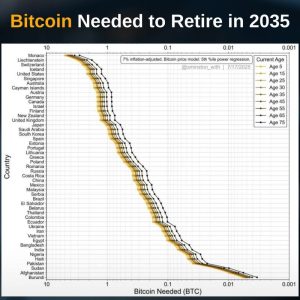
A viral chart asks how much Bitcoin you need to retire. It leaves out the two variables that actually decide the answer: where you are tax resident, and how your holding is structured.
The Question Everyone Is Asking, and the One They Are Not
A chart has been circulating recently that estimates how much Bitcoin someone needs, by current age and country of retirement, to retire comfortably by 2035 — built on a conservative, inflation-adjusted price model and a set of assumptions about cost of living by jurisdiction. It is a useful thought exercise, and the underlying instinct is correct: retirement number and geography are inseparable. It is also, deliberately, a simplification. It treats "where you retire" as a cost-of-living input and stops there.
For the international investors and family offices we advise, that is only half the equation. Where you are tax resident when a Bitcoin position is realised — sold, converted, or spent — determines what portion of the gain you actually keep, whether it is added to a wealth-tax base every year it sits unrealised, and how visible it already is to your tax authority before you make a single decision. Since 1 January 2026, DAC8 has put crypto-asset service providers under an EU-wide obligation to report client holdings to tax authorities, who exchange that data automatically across all member states. The jurisdiction question is no longer just about lifestyle. It is a structuring decision with a compliance clock already running.
The three jurisdictions Vicox Legal practises in — Spain, Portugal and Luxembourg — illustrate how differently the same retirement number can play out depending on where you land.
Spain: High Realisation Tax, but a Predictable System
Spain taxes capital gains from crypto disposals as savings income under the IRPF scale, and 2026 brought a change worth knowing about before you plan around an old figure: the top marginal rate on gains above €300,000 rose from 28% to 30%. The full scale for a Spanish tax resident realising crypto gains in a single year is 19% up to €6,000, 21% up to €50,000, 23% up to €200,000, 27% up to €300,000, and 30% above that threshold, applied progressively.
Unrealised holdings are a separate exposure. Spain's wealth tax (Impuesto sobre el Patrimonio) applies a progressive scale, generally running from 0.2% up to 3.5% depending on the autonomous community and the size of the estate, with non-residents benefiting from a €700,000 personal allowance on Spanish-situated assets before the tax applies. Residents of Madrid and Andalucía benefit from regional rebates on the standalone wealth tax, but large estates should still budget for the Impuesto de Solidaridad de las Grandes Fortunas, a national backstop that applies from roughly €3 million in net wealth regardless of regional rebates.
None of this makes Spain an unattractive jurisdiction for a crypto-funded retirement — quite the opposite. What it offers instead of a low headline rate is a stable, well-understood system: predictable notarial and banking infrastructure for converting realised gains into property or other durable assets, an established residency and NIE process for non-EU nationals, and a tax framework that, once modelled correctly, produces no surprises. The retirees who do well in Spain are the ones who plan the realisation schedule around the scale, rather than realising a large position in one tax year by accident.
Portugal: The 20% Regime Is Narrower Than Its Reputation
Portugal's old NHR regime, which for years fuelled its reputation as a low-tax destination for crypto holders, closed to new applicants at the end of its transitional phase in March 2025. It has been replaced by IFICI (the Tax Incentive for Scientific Research and Innovation, sometimes called "NHR 2.0"), which remains open to new applicants but is materially narrower: it applies a flat 20% rate to Portuguese-source employment or self-employment income, and only within designated high-value sectors such as research, innovation and technology. Applicants must also not have been Portuguese tax residents in the preceding five years.
What IFICI does not clearly provide is a blanket exemption for passive investment gains, including crypto disposals. A retiree living off periodic Bitcoin realisations, rather than active employment income in a qualifying sector, should not assume the 20% rate — or the general capital-gains exemption sometimes cited alongside it — automatically applies to their situation. This is one of the more common misconceptions we see among relocating crypto holders, and it is worth confirming against your specific income structure before, not after, you move.
Luxembourg: No Wealth Tax, Strong Holding Infrastructure
Luxembourg has not levied a net wealth tax on individuals — resident or non-resident — since it was abolished for individuals in 2006; only companies remain subject to a corporate net wealth tax. Combined with a sophisticated, CSSF-supervised financial and holding-company infrastructure, this makes Luxembourg a natural jurisdiction for the custody and structuring layer of a crypto-funded retirement plan, even when the retiree's actual residence is Spain or Portugal.
A common structure among the family offices we advise separates the two questions deliberately: a Luxembourg holding vehicle custodies and manages the digital asset position under a MiCA-authorised provider, while the individual's personal tax residency — and the realisation events that trigger income tax — sits in whichever jurisdiction offers the better lifestyle and cost-of-living fit. The two decisions do not have to be made in the same place.
Comparing the Three Jurisdictions
| Jurisdiction | Tax on Realised Crypto Gains | Wealth Tax Exposure | Best Fit For |
|---|---|---|---|
| Spain | 19%–30% progressive (IRPF savings scale, 2026) | 0.2%–3.5%, €700k non-resident allowance; Solidarity Tax above ~€3M | Residency, real estate deployment, day-to-day banking |
| Portugal | Standard rates outside IFICI; 20% flat only for qualifying active income in designated sectors | No general net wealth tax | Active-income relocators in qualifying sectors, not pure passive crypto retirees |
| Luxembourg | Depends on structure and holding entity | None for individuals since 2006 | Custody, holding-company and family-office structuring |
Why "Build It in the Bear Market" Applies to Structure, Not Just DCA
The instinct behind dollar-cost averaging into a bear market — build the position when sentiment is low, not when headlines are euphoric — applies with equal force to the legal side of a retirement plan. Structuring a holding vehicle, establishing tax residency, and documenting source of funds are all easier to do calmly, ahead of a realisation event, than under time pressure once a target price is hit and a large gain needs to be converted. DAC8 reporting and MiCA-authorised custody requirements do not pause for market cycles; the compliance groundwork done during a quiet period is what makes a large realisation, whenever it happens, straightforward rather than a scramble.
This is also the moment to decide whether some portion of the eventual gain will be deployed into durable assets rather than held as fiat — international investors increasingly use a compliant crypto-to-fiat structure to buy real estate with crypto in Spain as part of exactly this kind of retirement and residency plan, converting a volatile position into a fixed, inheritable asset at a time of their choosing rather than the market's.
Pre-Retirement Checklist for Crypto Holders Planning a Move
- Model your realisation schedule against the actual 2026 tax scale of your target jurisdiction, not a headline "low-tax" reputation
- Confirm whether any special regime (like Portugal's IFICI) actually covers your income type before relying on it
- Check wealth-tax exposure on unrealised holdings in your target country, including any national backstop tax
- Decide whether custody and holding structure should sit in a different jurisdiction from your personal residency
- Confirm the custodian or exchange handling any conversion holds valid MiCA authorisation
- Document source-of-funds history for every wallet before approaching a bank or notary
- Map out DAC8 reporting exposure across every jurisdiction where you hold assets or citizenship
- If part of the plan involves buying property, complete standard due diligence independently of the funding source
- Time structural changes — residency, entity formation — for calm periods, not post-realisation crunches
Frequently Asked Questions
How much Bitcoin do I actually need to retire in Spain?
There is no single figure — it depends on your target income, current age, and the tax scale that applies when you realise gains. What changed in 2026 is the top rate: gains above €300,000 in a single tax year are now taxed at 30% in Spain, up from 28%, which makes the realisation schedule (spreading disposals across multiple years) as important as the total position size.
Does Portugal still offer 0% tax on crypto gains?
No, not as a blanket rule. The NHR regime that fuelled that reputation closed to new applicants in March 2025. Its replacement, IFICI, applies a flat 20% rate only to qualifying active income in designated high-value sectors — it does not clearly extend a general exemption to passive crypto disposals, so retirees living off realised gains should confirm their specific treatment rather than assume it.
Is there a wealth tax on Bitcoin holdings in Spain?
Yes. Spain's Impuesto sobre el Patrimonio applies a progressive scale of roughly 0.2% to 3.5% on worldwide assets for residents, with non-residents taxed on Spanish-situated assets subject to a €700,000 personal allowance. Large estates should also budget for the national Solidarity Tax on Large Fortunes, which applies from around €3 million regardless of regional rebates.
Can I avoid Spanish wealth tax by moving my crypto holding to Luxembourg?
Luxembourg has not levied a net wealth tax on individuals since 2006, which is why it is commonly used as a custody and holding-company jurisdiction. However, your personal tax residency — not just where the holding vehicle sits — is what determines your exposure to Spanish wealth tax, so this requires proper structuring rather than simply opening an account abroad.
What is DAC8 and why does it matter for a retirement plan built on crypto?
DAC8 is the EU directive that, from 1 January 2026, requires crypto-asset service providers to report client holdings and transactions to tax authorities, who then exchange that data automatically across all EU member states. It means your digital asset position is visible to your country of tax residence regardless of where it is custodied within the EU, which is why structuring should happen before large realisation events, not after.
Should I realise my Bitcoin gains before or after establishing tax residency in a new country?
This depends on your specific circumstances and the tie-breaker rules of any applicable double tax treaty, but the sequencing matters a great deal — realising a large gain shortly before or after a residency change can determine which country has primary taxing rights over it. This is exactly the kind of decision that should be modelled with legal and tax advice in advance, not decided by timing convenience.
Structure Your Crypto Retirement Plan — Before the Realisation, Not After
Vicox Legal advises HNWIs, family offices and crypto investors on cross-border retirement planning, tax residency and wealth structuring across Spain, Portugal and Luxembourg — including compliant crypto-to-fiat structures for investors ready to buy real estate with crypto.